Threshold Rebalancing and When a Weight Breach Triggers a Trade
In this chapter
Intermediate
Threshold rebalancing uses a measured change in portfolio weight to decide when to trade. A policy might say “Check each Friday. If stocks are below 55% or above 65%, return them to their 60% target.” A week ending at 65% passes this specific rule. A Friday ending at 66% calls for a trade.
A complete instruction tells the manager when to look, what counts as a trigger and where to take the weights afterward. Change any one of those parts and you can get a different trade from the same statement.
Specify three parts of the rule
| Policy part | What to record |
|---|---|
| Observation | The weekday or dates to measure weights, valuation time and holiday handling |
| Trigger | The threshold and whether a point exactly on the boundary fires it |
| Reset destination | The weight or mix to restore after a trigger, such as the long-term target or a stated point within the permitted range |
The reset destination is where you aim to land. It can differ from both the trigger and the normal target. A calendar reset uses the date as its decision rule. A threshold rule uses the measured weight at the dates you monitor.
Let \(w_t\) be the actual weight at observation \(t\) and \(w^*\) be the target. The signed drift in percentage points is \(d_t=w_t-w^*\) when the two weights are written as percentages. For a positive target, relative drift is \(d_{\mathrm{rel}}=(w_t-w^*)/w^*\). At a 60% target, 66% is 6 percentage points high and 10% above target on a relative basis. A band of 5 percentage points runs from 55% to 65%. A band of 5% of the target runs from 57% to 63%. Spell out the unit because the checks differ.
Worked application 1. Follow five Friday checks
Use a two-asset USD portfolio with a 60% equity and 40% bond target. Here the policy checks at Friday close, or at the last business close of the week if Friday is closed. It trades at the measured prices whenever equities are strictly outside the 55%–65% inclusive band. The destination is 60% equities. Ignore taxes, fees and external flows. Use the portfolio’s unrounded market-value weights for the rule. The exact weights below are supplied observations on the actual path under this policy.
| Friday close in 2028 | Equity before decision | Gap to 60% target | Result | Equity after decision |
|---|---|---|---|---|
| 1 September | 60% | 0 pp | Within the range | 60% |
| 8 September | 65% | +5 pp | At the upper boundary | 65% |
| 15 September | 66% | +6 pp | Upper breach, reset | 60% |
| 22 September | 56% | −4 pp | Within the range | 56% |
| 29 September | 55% | −5 pp | At the lower boundary | 55% |
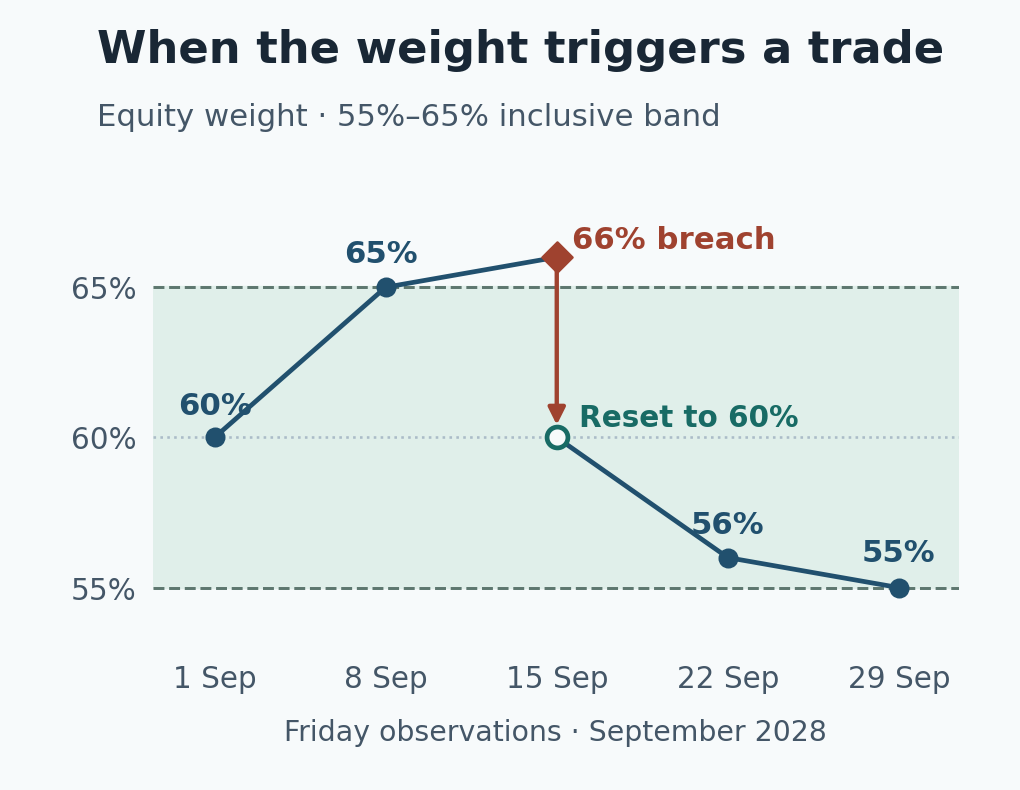
On 15 September the total is $100,000.00 at the close. Equity is $66,000.00 and bonds are $34,000.00. Sell $6,000.00 of equity and buy the same amount of bonds to reach $60,000.00 and $40,000.00. Selling $1,000.00 would take equity only to the upper boundary. This policy calls for a full reset.
Suppose a midweek observation showed 67% but the following Friday read 65%. Under the example rule a routine threshold trade is decided from the Friday value. A separate intraday exposure limit could have its own response, if the policy defined one.
Worked application 2. Change the destination or boundary
First keep the same trigger and change the destination to 63% for an upper-side breach. Through 15 September the same observations apply, because the first trigger occurs on that date either way. At the $100,000.00 total, the new instruction sells $3,000.00 of equities to reach $63,000.00 and adds $3,000.00 to bonds. The trade is half the size of the full reset, and it leaves equities 3 percentage points over the long-term target. The small remaining cushion to the upper boundary may matter if prices keep moving. Consider trading costs when deciding how far to reset.
Now suppose the policy instead fires as soon as equity reaches or exceeds 65% at an observation. It uses the 63% destination for an upper trigger. On 8 September, if the total is $100,000.00, the same 65% observation leads to a $2,000.00 sale. That is a week earlier than in the first case. Once the earlier trade is made, later weights have to be recomputed from the new holdings. You cannot reuse the printed later path as the outcome of the new rule.
Keep a usable audit record
Record observed weights before trade, the unrounded trigger result, the trade and the weight reached. A displayed 65.00% can come from a value slightly above or below it, so apply the policy’s measurement precision before making the call. Set a review rule for unavailable markets or cash. This makes it clear whether the trade matched the policy the next time someone reads the record.
Practice questions
Choose one answer per question. Dollar amounts are in USD. Round only the final result where a question calls for rounding.
1. Read the boundary wording
The rule says to trade only strictly above 65%. The observed weight is exactly 65% at a scheduled check. What happens?
2. Convert to relative drift
Equity goes from a 40% target to 44%. What is the relative drift as a share of the target?
3. Use the approved destination
Equities weigh 68% in a $150,000.00 portfolio. A breach has triggered, and the destination is 62%. What equity trade is required at fixed prices before costs?
4. Read an off-schedule observation
Weights are monitored only on the last trading close of each week. Equity is 66% on Wednesday and 64% at Friday’s close. Only readings above 65% trigger this rule. What does it require?
5. Use the unrounded value
A dashboard displays 65.00%, but the policy uses unrounded weights and trades strictly above 65%. The unrounded weight is 65.004%. What should the manager record?
6. Understand a different trade history
An alternative rule triggers a week earlier and alters the holdings. What should you do when judging the next week’s threshold?