Bond Basics and How a Bond’s Payments Work
In this chapter
Beginner
When you buy a bond, you buy the right to receive the payments in its terms. The borrower who promises those payments is the issuer. The investor who holds that right is the bondholder. If you buy at issue, your purchase helps fund the borrower. If you buy the same bond a year later from another investor, your money goes to that seller and the borrower still has payment dates to meet.
Read the promise before you look at the price
A plain fixed-rate bond gives you the information needed to draw a cash-flow timeline. Start with the issuer’s name. Then find the face value, the coupon rate, the payment dates and the maturity date.
| Term | What to look for in this bond |
|---|---|
| Face value | The stated principal, which is the principal repayment at maturity in this example |
| Coupon | A scheduled cash interest payment |
| Coupon rate | The annual percentage applied to face value to find the annual coupon cash in this example |
| Maturity | The date the final scheduled payments come due |
| Redemption amount | The principal payment specified in the terms. Redemption at par pays the face value. |
The coupon tells you how much interest comes in on a payment date. The redemption amount tells you how much principal comes back. An investor may see both on the same date. Some bonds pay floating coupons or return principal in instalments. The two cases here follow one bond with a fixed annual coupon and all principal due at the end.
Worked example 1. Trace a new bond from both sides
Maple Transit, a hypothetical company, issues a three-year bond on 15 January 2030. You pay its face value of $1,000.00 at issue. Its 6.00% annual fixed coupon pays $60.00 each 15 January from 2031 through 2033. The bond matures at par on 15 January 2033. All amounts are USD. Assume prompt payment, with fees, taxes and reinvestment outside the calculation.
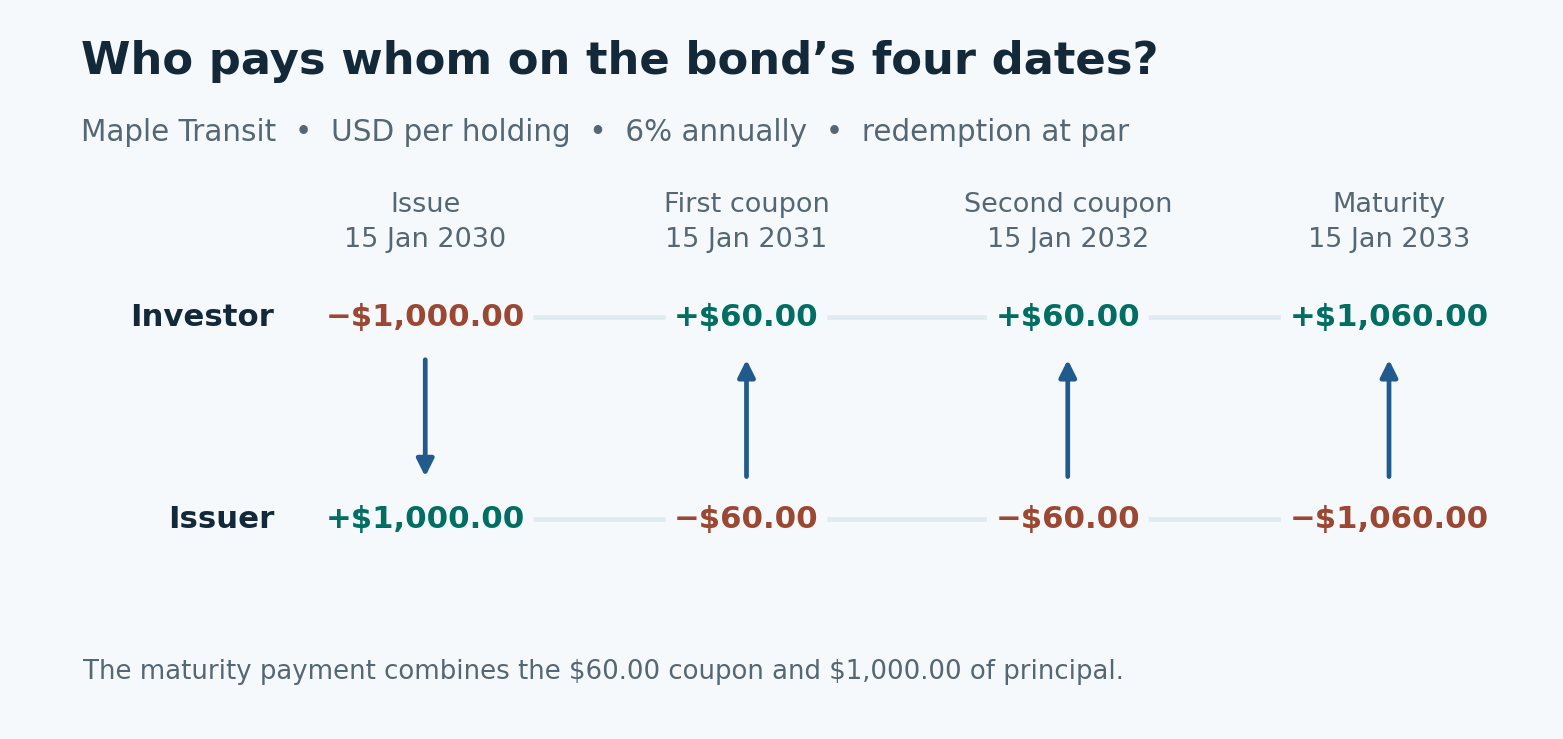
| Date | What happens | Your cash flow | Maple Transit’s cash flow |
|---|---|---|---|
| 15 Jan 2030 | Bond is issued at par | −$1,000.00 | +$1,000.00 |
| 15 Jan 2031 | First coupon | +$60.00 | −$60.00 |
| 15 Jan 2032 | Second coupon | +$60.00 | −$60.00 |
| 15 Jan 2033 | Final coupon and $1,000.00 principal | +$1,060.00 | −$1,060.00 |
The two columns use opposite signs because every payment leaves one party and reaches the other. Over the three years you receive $180.00 in interest. The $1,000.00 repaid at the end is principal. Your receipts sum to $1,180.00, and you originally paid $1,000.00. Subtracting the two gives $180.00 of net cash over the three years. To express performance as an annual return, the dates also matter. You received two of those coupons before the last year ended.
Worked example 2. Follow the same bond after it changes hands
You receive the first coupon on 15 January 2031 and sell immediately afterwards for $970.00. The trade settles that day, just after payment, with zero accrued interest in this example. A second investor pays you the $970.00. They now hold the right to the 2032 and 2033 payments.
| Cash event | Who pays? | Who receives it? | Amount |
|---|---|---|---|
| First coupon | Maple Transit | You | $60.00 |
| Sale after the first coupon | New investor | You | $970.00 |
| Second coupon | Maple Transit | New investor | $60.00 |
| Final coupon and principal | Maple Transit | New investor | $1,060.00 |
You receive $1,030.00 on the sale date including the first coupon. The new investor pays $970.00 for future receipts totalling $1,120.00, assuming Maple Transit pays as promised. Maple Transit received $1,000.00 once, when it issued the bond. The $970.00 is a trade between investors. The new holder’s lower purchase price gives them a different starting point for measuring their return, while the issuer still owes the amounts in the original agreement.
Why might the next buyer pay a different price?
A buyer can compare this bond’s remaining payments with what other bonds offer. If comparable borrowers start offering higher interest rates, those old $60.00 payments may appeal only at a lower price. The price can also move if investors change their view of Maple Transit’s ability to pay. The bond’s payment schedule tells you what the borrower owes. A market quote tells you what someone would pay now for the rights to the future payments.
Practice questions
Choose one answer per question. Use the assumptions stated in each question. Dollar amounts are in USD. Round only your final result.
1. Who gets the issue money?
A company issues a new bond directly to you at $1,200.00. Who receives your purchase money?
2. Read the final receipt
A three-year bond redeems at its $800.00 face value and pays a $32.00 annual coupon. Both final payments arrive on time. How much comes in at maturity?
3. Follow a trade
The original investor sells a bond to a second investor just after the first coupon. Who pays the original investor the agreed sale price?
4. Read a cash-flow sign
An issuer repays $500.00 of principal to the holder. Which entry belongs in the issuer’s cash-flow column for that repayment?
5. Check what the contract promises
A bond’s terms promise $900.00 principal at maturity and $45.00 interest annually. Someone buys it for $870.00 immediately after a coupon. The issuer pays on schedule. How much principal does the new holder receive at maturity?
6. Count the first holder’s receipts
You pay $1,100.00 at issue, receive one $55.00 coupon, and sell the bond immediately after that coupon for $1,070.00. What are your combined cash receipts on that sale date before costs?