Bond Price–Yield Relationship and Why Prices Move
In this chapter
Intermediate
A fixed-rate bond’s price falls when the yield used to value its remaining cash flows rises. The bond still promises the same checks on the same dates. A buyer who asks for a higher return is willing to pay less today for those checks.
Turn the promise into today’s price
A bond with regular coupons and all principal due at maturity has two parts to value. The coupons form a series of equal payments. The principal redemption is a single cash flow on the last coupon date. If you are comfortable with the present value of an annuity, that is one way to value the coupon part. You can also discount each dated payment and add the results.
\[ P=\sum_{t=1}^{n}\frac{C}{(1+i)^t}+\frac{F}{(1+i)^n} \]
| Symbol | What to use |
|---|---|
| \(P\) | Full price at the valuation date for the holding, in USD |
| \(C\) | Regular coupon cash each period, in USD |
| \(F\) | Scheduled redemption in USD, equal to face value in these examples |
| \(i\) | Yield per coupon period in decimal form |
| \(t\), \(n\) | A payment’s period number and the total number of regular periods remaining |
The \(t=n\) term already counts the last coupon. \(F\) counts the principal due on the same date. Use a consistent date and compounding basis. With semiannual coupons and a nominal annual yield compounded semiannually, divide the annual quote by two to get \(i\). A 4.00% nominal annual quote means a 2.00% half-year discount rate.
Worked example 1. Reprice six payments at three yields
Harbor Rail issues a plain USD bond on 15 January 2030. It pays a 6.00% fixed annual coupon, split into $30.00 payments each 15 July and 15 January on $1,000.00 face. It matures at par on 15 January 2033. Value it on the issue date, with six equal periods remaining, zero accrued interest and all payments assumed on time. Ignore fees and taxes. With zero accrued interest at issue, the full price equals the clean price in this example.
At an 8.00% nominal annual yield, divide the first $30.00 by 1.04. Its present value is $28.85. The last payment is $1,030.00 six periods away. Divide it by \(1.04^6\) to get $814.02. Calculate the four other $30.00 payments with their own exponents, add all six unrounded values and round the final price.
| Nominal annual yield | Yield per half year | Present value of six coupons | Present value of principal | Full price |
|---|---|---|---|---|
| 4.00% | 2.00% | $168.04 | $887.97 | $1,056.01 |
| 6.00% | 3.00% | $162.52 | $837.48 | $1,000.00 |
| 8.00% | 4.00% | $157.26 | $790.31 | $947.58 |
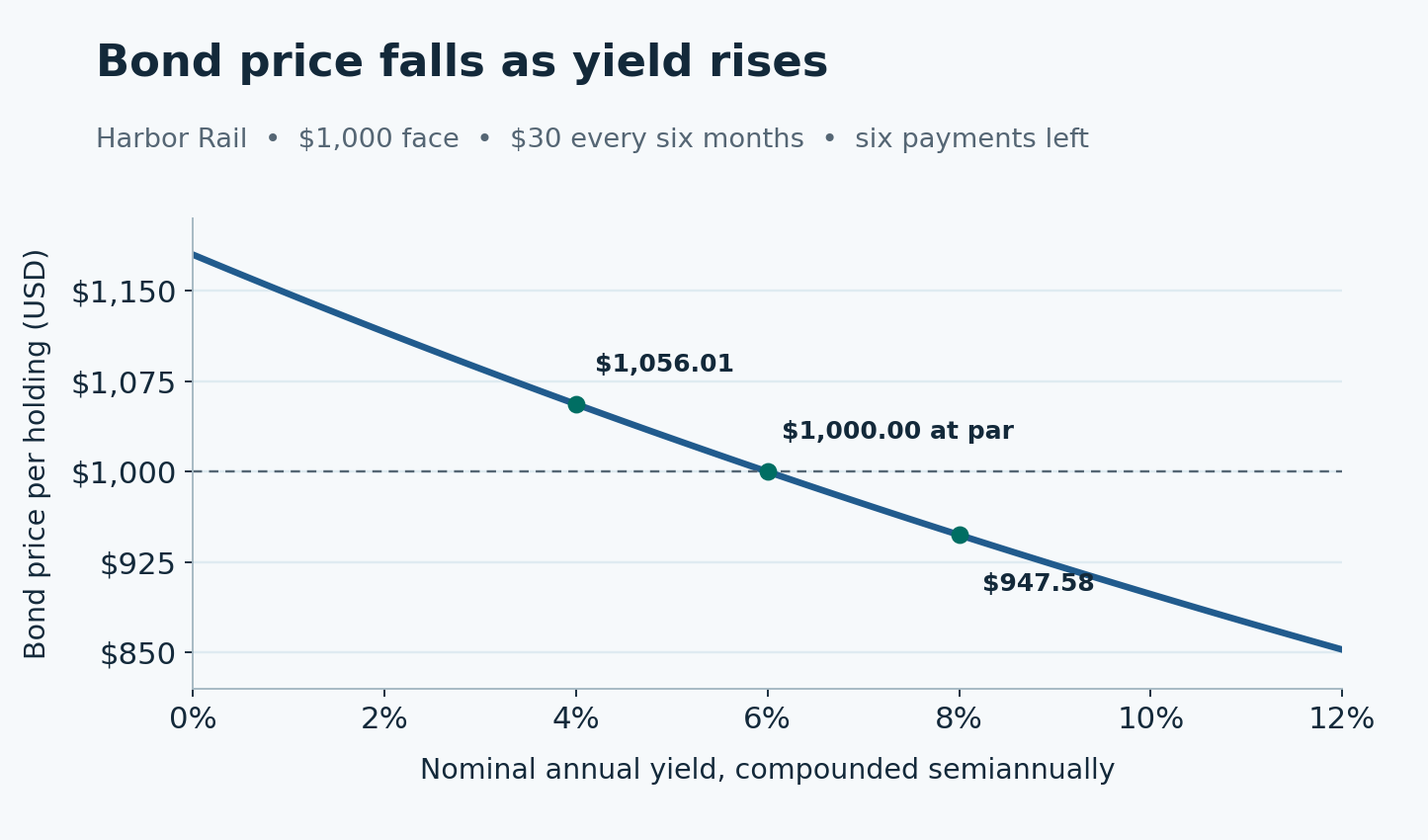
At 6.00% yield the bond is at par, equal to its $1,000.00 face value. At 4.00%, $30.00 each half year gives more coupon cash than 2.00% of par, so the price includes a premium above par. At 8.00% the coupon is less than 4.00% of par per half year. The bond trades at a discount to par. At par the coupon corresponds exactly to what the market requires on that principal balance each period.
Worked example 2. Change the coupon, then repeat the same yield move
Suppose Harbor Rail also has a bond with the same face amount, dates, repayment terms and payment risk, but a 2.00% annual coupon. Its cash coupon every six months is $10.00. Value both on 15 January 2030 while the market yield moves from 6.00% to 8.00% nominal annually. For each bond measure the price drop as a percentage of its own price at 6.00%.
| Fixed coupon rate | Price at 6.00% yield | Price at 8.00% yield | Percentage price change |
|---|---|---|---|
| 6.00% | $1,000.00 | $947.58 | −5.24% |
| 2.00% | $891.66 | $842.74 | −5.49% |
The last principal payment accounts for a larger share of the low-coupon bond’s price. A change in the discount rate has more periods to work on that part of the value. Here the low-coupon bond falls more in percentage terms. In dollar terms, the 6.00% coupon bond loses $52.42 and the 2.00% coupon bond loses $48.92. The higher-coupon bond starts from a higher price.
For a larger yield change, a duration and convexity estimate accounts for the bend in the bond’s price curve.
Read the curve at one date
Each point on a price–yield curve values the same schedule on the same date. That is what lets you isolate the yield change. If a coupon is paid or a year passes, update the schedule first. If the issuer’s credit worsens or the bond has terms that can change the dates or amounts, revisit the cash flows as well. You can read the relationship in either direction. Given a yield, find a price. Given a full price, solve for the yield implied by the promised payments.
A market yield curve shows yields across maturities at a given time.
Practice questions
Choose one answer per question. Use the assumptions stated in each question. Dollar amounts are in USD. Round only your final result.
1. Choose the right period rate
A bond pays every six months. Its market yield is 7.20% nominal annually, compounded semiannually. What rate discounts each period?
2. Read a par crossing
A regular bond redeeming at par pays a 5.00% annual fixed coupon once a year. Just after a coupon, the market yield is 5.00% effective annually. Where does the price sit?
3. Discount two payments
A $1,000.00 face bond pays $40.00 annually. Exactly two years remain and it repays at par. Value it at 6.00% effective annual yield just after a coupon. What is the price?
4. Isolate a yield increase
You keep the same future payments and valuation date. The yield rises. What happens?
5. Compare percentage sensitivity
Two otherwise matched regular bonds differ only in the fixed coupon amount. Which typically has the larger percentage price decline for the same increase in yield from a common starting yield?
6. Count the last date once
A plain bond pays $25.00 every six months and redeems $1,000.00 at the last date. If you enter each date as a single combined cash flow, what should you enter for that last date?