Payment-in-Kind Bonds and How Interest Adds to the Debt
Build a PIK debt schedule from opening principal, compare cash-pay and cash-plus-PIK terms, and calculate the final balance after an interest election.
In this chapter
Intermediate
A payment-in-kind bond, often called a PIK bond, can pay interest by increasing the debt owed rather than handing the holder cash at that date. Depending on the contract, the issuer adds principal to the existing note or issues additional notes.
If $1,000 earns 8% entirely in PIK for a year, $80 is added and the next opening balance is $1,080. If the next year's 8% applies to that increased balance, it adds $86.40. The issuer saves cash now while the eventual debt payment grows.
PIK is a contractual payment method. A borrower failing to pay an ordinary cash coupon cannot simply decide to call that failure PIK.
Build each period from the opening balance
For a full annual period with no principal retirement:
\[ I_{\text{PIK},t}=B_{t-1}p_t,\qquad I_{\text{cash},t}=B_{t-1}c_t,\qquad B_t=B_{t-1}+I_{\text{PIK},t}. \]
\(B_{t-1}\) is opening principal for year \(t\), \(B_t\) is closing principal after capitalisation, \(p_t\) is the annual PIK rate and \(c_t\) the annual cash coupon rate, both decimals for that full year. \(I_{\text{PIK},t}\) is dollars added to debt and \(I_{\text{cash},t}\) dollars paid as cash. Cash interest does not reduce principal in this model.
If a fixed all-PIK rate \(p\) is capitalised annually for \(n\) years:
\[ B_n=B_0(1+p)^n. \]
\(B_0\) is original principal. This is a debt-balance application of compounding. For half-year capitalisation or partial periods, use the contract's actual rate and accrual rules; do not apply a full annual rate repeatedly.
Worked application 1. Three years of all-PIK interest
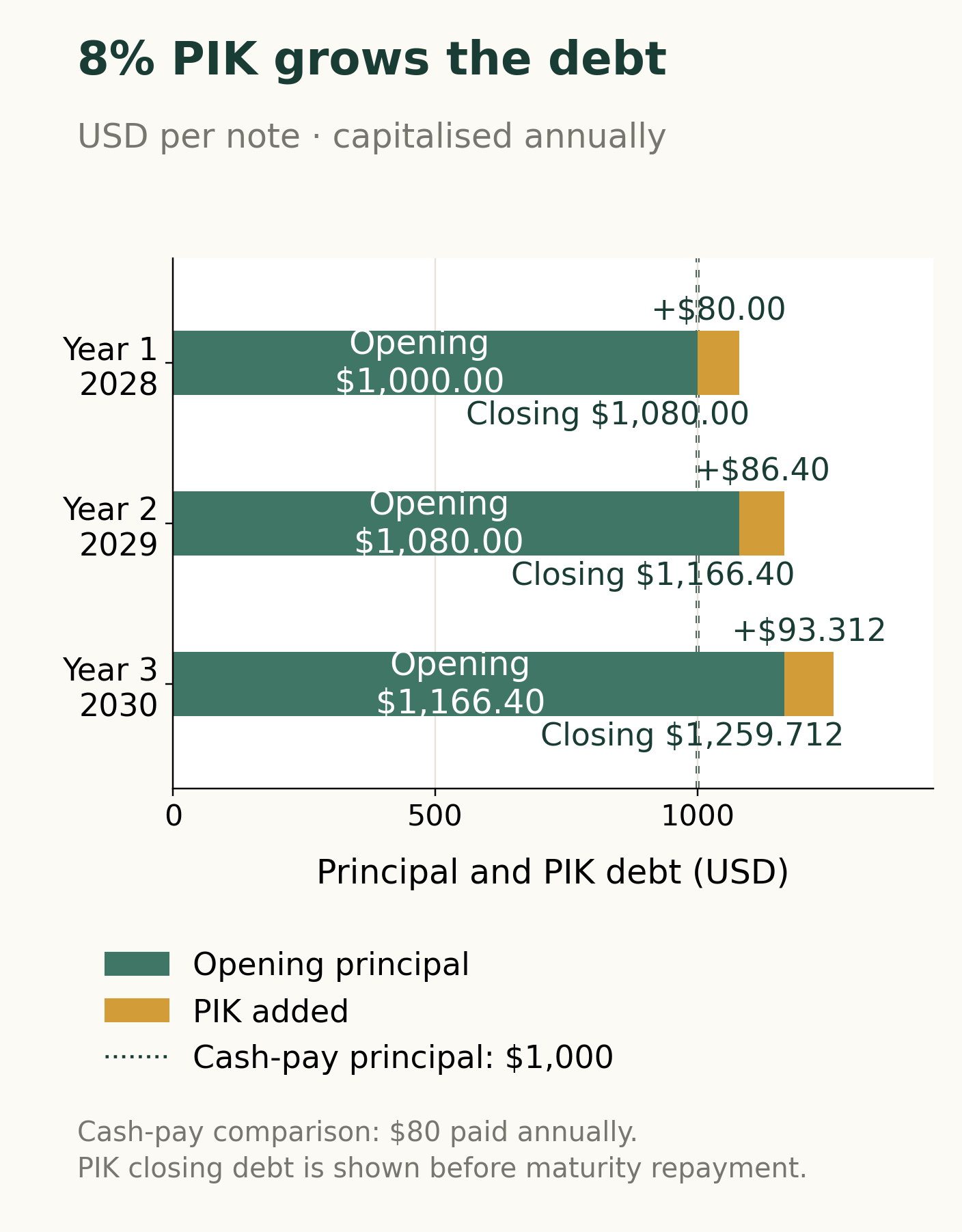
Willow Software Inc. issues a fictional senior unsecured $1,000 note on 1 January 2027, maturing on 1 January 2030. It pays 8% annual interest entirely by adding principal on each 1 January in 2028, 2029 and 2030. The final capitalisation occurs immediately before maturity repayment. All principal, including capitalised PIK, is due in cash at maturity. No interim cash coupon, call, put or principal repayment applies. Figures are USD; ignore fees and taxes.
| Capitalisation date | Opening principal (USD) | PIK at 8% (USD) | Cash coupon (USD) | Closing debt before any maturity repayment (USD) |
|---|---|---|---|---|
| 1 January 2028 | $1,000.00 | $80.00 | $0.00 | $1,080.00 |
| 1 January 2029 | $1,080.00 | $86.40 | $0.00 | $1,166.40 |
| 1 January 2030 | $1,166.40 | $93.31 | $0.00 | $1,259.71 |
The exact third-year addition is $93.312, and the exact ending debt is $1,259.712. The table displays cents; the calculations retain the full balance until the final settlement of $1,259.71. The first $80 now forms part of the interest base, so the annual additions rise despite the unchanged rate.
Compare a separate 8% cash-pay note with the same $1,000 face and maturity. It pays $80 in 2028 and 2029, then $80 plus $1,000 in 2030. Its principal stays $1,000 until redemption.
| Date | All-PIK cash receipt (USD) | Cash-pay receipt (USD) |
|---|---|---|
| 1 January 2028 | $0.00 | $80.00 |
| 1 January 2029 | $0.00 | $80.00 |
| 1 January 2030 | $1,259.71 | $1,080.00 |
The larger final PIK number is not free extra value. If the cash-pay holder could reinvest the first $80 for two years and the second $80 for one year at 8%, its maturity wealth would also be $1,259.712 before rounding. Without that reinvestment, its receipts remain spread across dates. Credit risk and the ability to turn PIK debt into actual cash also matter.
Worked application 2. Elect part cash and part PIK
Now use a different Willow contract. Before each annual accrual period the issuer must elect either 8% all-PIK or 4% cash plus 4% PIK, with the election applying for that entire period. The two branches deliberately have the same stated total rate here. Real toggle terms may charge different rates.
Willow elects 4% cash plus 4% PIK in each of the first two years, then elects 8% all-PIK in the third year. PIK is added on the same dates, and all outstanding principal is due on 1 January 2030.
| Year ending | Opening principal (USD) | Cash rate | PIK rate | Cash paid (USD) | PIK added (USD) | Closing debt (USD) |
|---|---|---|---|---|---|---|
| 1 January 2028 | $1,000.00 | 4% | 4% | $40.00 | $40.00 | $1,040.00 |
| 1 January 2029 | $1,040.00 | 4% | 4% | $41.60 | $41.60 | $1,081.60 |
| 1 January 2030 | $1,081.60 | 0% | 8% | $0.00 | $86.53 | $1,168.13 |
For the final year, \(1,081.60\times0.08=86.528\), so exact maturity debt is $1,168.128. The holder receives that balance in cash at maturity, rounded to $1,168.13, after earlier cash coupons of $40 and $41.60.
Compared with all-PIK, the final debt is lower by:
\[ \$1,259.712-\$1,168.128=\$91.584, \]
or $91.58 displayed. The earlier cash outlay was $81.60. The $9.984 difference comes from PIK that no longer compounds on cash interest already paid. Simply subtracting $81.60 from the all-PIK final balance would miss that effect.
The word toggle describes the permitted switch between stated cash and PIK payment modes. You still need the election deadline, rates, principal base and settlement mechanics. A stated 10% PIK election is not numerically equivalent to an 8% cash election.
A growing balance and a growing risk are different measurements
PIK can preserve issuer cash when a project is not yet generating much money. It also leaves a larger claim to refinance or repay. A holder's contractual balance may rise while the bond's market value falls if repayment becomes less likely.
Keep three records separate: cash actually received, principal legally added and the estimated value of the resulting claim. The PIK schedule calculates the first two under the contract. Valuing the credit claim requires an additional required return and a view of repayment risk.
Practice questions
Choose one answer per question. Use the stated contract, dates and rate convention. Hypothetical money amounts are USD; ignore fees and taxes unless stated. Round only the final displayed answer.