Convertible Bond Floor and How to Value the Debt Component
Discount a convertible's debt payments at a comparable credit yield. Compare the estimate with parity and see how credit changes move the conditional floor.
In this chapter
Intermediate
The straight-debt value of a convertible is an estimate of what its retained bond payments would be worth without the conversion feature. It is often called the bond floor, but it is an estimate that can move with credit yields and contract terms.
For a simple voluntarily and immediately convertible bond, compare that debt estimate with the shares available on conversion. Under suitable assumptions, the greater of those values provides a valuation lower-bound comparison. It is not a guaranteed cash redemption amount or a complete convertible market price.
Strip out the option without changing the debt claim
Keep the issuer, currency, seniority, coupon schedule and promised principal of the comparison debt. Remove the equity conversion right. Our simple structure also has no issuer call, holder put, deferral or other option requiring a separate adjustment.
Use a required yield on comparable straight debt of the issuer's risk and terms, not a government rate and not the convertible's own hybrid yield. The credit spread, ranking, maturity and liquidity comparison can materially affect the result.
For annual coupon-date valuation:
\[ B=\sum_{t=1}^{n}\frac{C_t}{(1+y_d)^t}+\frac{F}{(1+y_d)^n}. \]
\(B\) is estimated straight-debt value in USD per bond; \(C_t\) is the USD coupon in year \(t\); \(F\) is USD principal at final redemption; \(n\) is remaining years; and \(y_d\) is the constant comparable annual-effective straight-debt required yield as a decimal.
This promised-payment discounting uses a credit-risky required yield in a simplified model. It does not assume every default outcome has separately been forecast. A risk-free expected-cash-flow model would require different inputs and consistent risk treatment.
Worked application 1. Estimate the debt component
Northstar Robotics Inc.'s fictional senior unsecured convertible has $1,000 face, three remaining $40 annual coupons and $1,000 maturity principal. Value it on 1 January 2027; coupons are due 1 January 2028, 2029 and 2030, with principal also due in 2030. Voluntary conversion into 25 Northstar shares is immediately available. No call, put, deferral, reset or mandatory conversion applies.
All amounts are USD. Assume zero accrued interest and no fees, taxes, fractions or settlement delay. Retaining the bond preserves its full debt rights. For this case, comparable straight debt requires 8% annual effective.
| Date | Coupon (USD) | Principal (USD) | Total debt payment (USD) | Present value at 8% (USD) |
|---|---|---|---|---|
| 1 January 2028 | $40.00 | $0.00 | $40.00 | $37.04 |
| 1 January 2029 | $40.00 | $0.00 | $40.00 | $34.29 |
| 1 January 2030 | $40.00 | $1,000.00 | $1,040.00 | $825.59 |
\[ B=\frac{40}{1.08}+\frac{40}{1.08^2}+\frac{1,040}{1.08^3} \approx\$896.92. \]
Add unrounded components before rounding. The displayed component cents happen to sum to the same amount here, but that is not the calculation rule.
At a $30 stock quote, conversion value is \(25\times30=\$750\). Debt value is the larger estimate. At $36 stock, parity is $900, just above $896.92.
For this simple structure, write the conditional comparison:
\[ L=\max(B,qS). \]
\(L\) is a model lower-bound comparison in USD per bond, \(q\) is shares per bond and \(S\) USD per share. Do not add \(B\) and \(qS\). On conversion you replace the bond claim with shares; you do not receive both whole claims.
| Share price (USD/share) | Conversion value (USD/bond) | Debt estimate at 8% (USD/bond) | Greater-of comparison (USD/bond) |
|---|---|---|---|
| $20.00 | $500.00 | $896.92 | $896.92 |
| $30.00 | $750.00 | $896.92 | $896.92 |
| $34.00 | $850.00 | $896.92 | $896.92 |
| $36.00 | $900.00 | $896.92 | $900.00 |
| $40.00 | $1,000.00 | $896.92 | $1,000.00 |
| $50.00 | $1,250.00 | $896.92 | $1,250.00 |
| $60.00 | $1,500.00 | $896.92 | $1,500.00 |
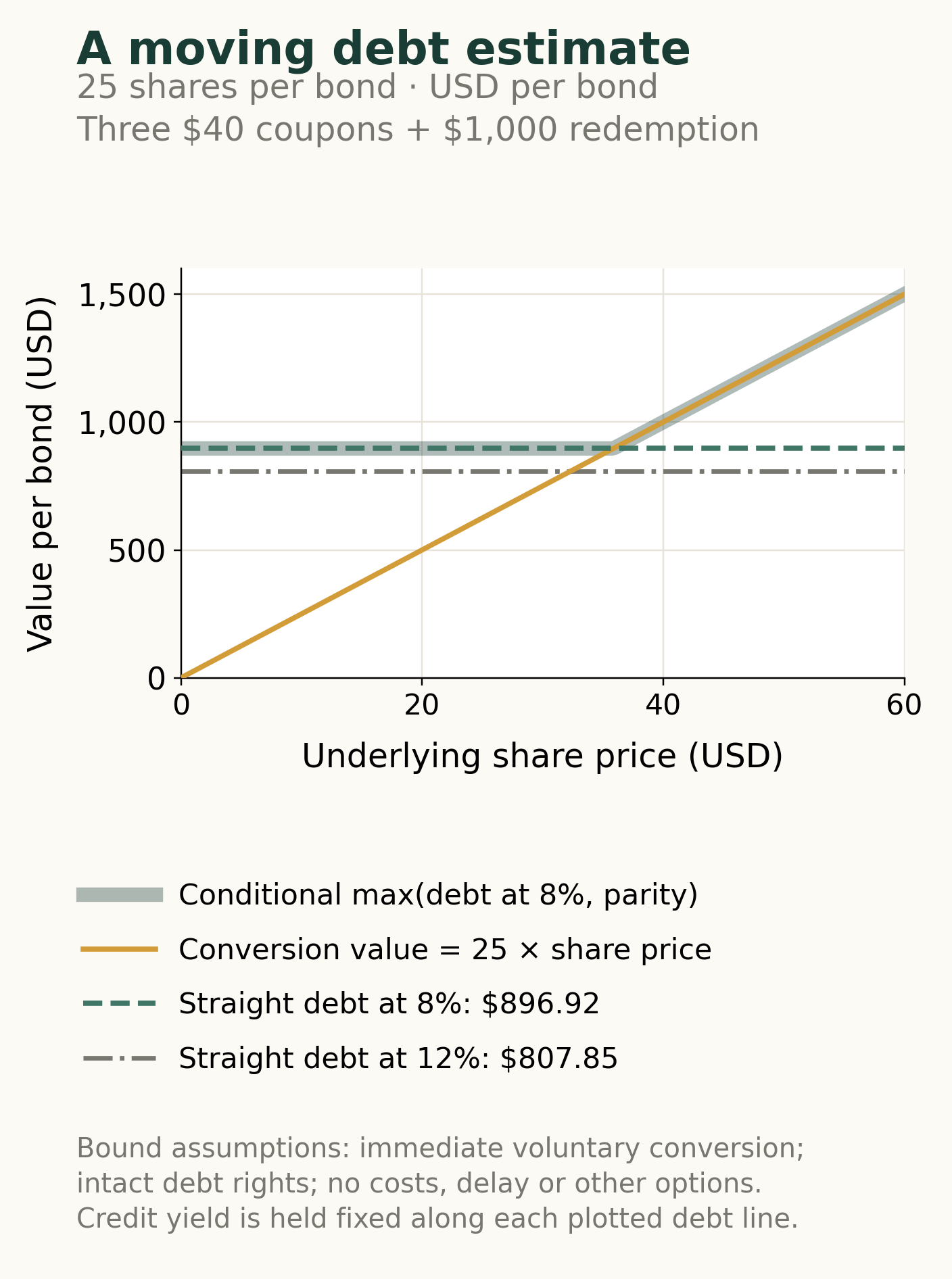
What makes the comparison a conditional bound?
The holder must be able to retain the debt claim voluntarily or convert at the stated terms. The straight-debt estimate must be appropriate to those retained rights. Immediate parity also assumes the shares can actually be delivered and valued on a consistent basis.
In a frictionless model with valid inputs, taking away a voluntary conversion right should not make the otherwise identical debt more valuable. But an estimated “floor” is not an executable cash bid. Model error, credit deterioration, illiquidity or different settlement rights can make a real comparison less secure.
The market price can exceed \(L\), because flexibility to convert later can have value. That additional value is not measured merely by calling \(L\) a floor.
Worked application 2. Credit yield lowers the debt support
Keep every promised payment and conversion term, but increase the comparable annual-effective debt yield to 12%. The new estimate is:
\[ B_{12\%}=\frac{40}{1.12}+\frac{40}{1.12^2}+\frac{1,040}{1.12^3} \approx\$807.85. \]
The decline from the 8% estimate is about $89.06 per bond. At a $34 stock quote, parity remains $850 because neither the ratio nor share price changed.
| Comparable debt yield | Debt estimate (USD) | Parity at $34 (USD) | Greater-of comparison (USD) | Larger component |
|---|---|---|---|---|
| 8% | $896.92 | $850.00 | $896.92 | Debt estimate |
| 12% | $807.85 | $850.00 | $850.00 | Conversion value |
The share price at which parity equals the debt estimate is \(S^*=B/q\). Using unrounded values, it moves from about $35.8766 per share at 8% to $32.3141 at 12%. This crossover is distinct from the contractual conversion price.
The debt support moves, even though principal remains $1,000 on paper. If coupon or repayment terms change, rebuild the debt schedule as well as reconsidering the yield. A mandatory-conversion feature that removes the holder's right to keep debt through maturity would also change the logic behind the comparison.
The option-adjusted spread lesson explains why embedded features need more than an ordinary yield comparison. The floor calculation is one useful component estimate within that larger task.
Practice questions
Choose one answer per question. Use the stated contract, dates and rate convention. Hypothetical money amounts are USD; ignore fees and taxes unless stated. Round only the final displayed answer.